
Walking has several great benefits for your body and mind. It’s a calm, relaxing exercise that improves your mood while increasing your heart rate and circulation. However, walking isn’t as beneficial for lower-body strength as you might expect. To combat age- or disease-related muscle loss, walking alone won’t keep you strong.
Those who’ve already noticed lower-body weakness may benefit from physical therapy and strength exercises. Trained therapists tailor the exercises for your specific health issues and limitations. They’ll also determine which areas of your body need strengthening, often including exercises you can do at home. For more information on what therapists suggest for those over 60 to strengthen their legs and hips, keep reading.
Walking and Strength – What to Do Instead
Evidence shows that age-related muscle loss begins at 40, costing seniors approximately 50% of their muscle by their eighties 1. Although walking is easy and completely free, it won’t halt this process of losing strength. Adding side leg raises 2, heel raises 3, and other exercises a couple times a week strengthens your lower muscles and joints. Let’s take a look at the activities your physical therapist may recommend.
Weight lifting training
According to experts, older adults should be doing 150 minutes of moderate-intensity aerobics each week 4. This may include brisk walking to improve heart health. However, these experts also state that seniors should add strength training to their routine. Doing so ensures you’ll maintain muscle mass, particularly in the lower body.
Studies show that heavy strength training offers the highest muscle improvements 5. However, seniors often suffer from osteoporosis, hypertension, COPD, and other conditions.
That’s why seniors should begin with lighter weights and more repetitions, especially if you’ve been inactive for a while. Over time, as your body becomes stronger, you can increase the weight.
Functional training
Walking is an easy workout that costs nothing. However, seniors don’t always have the strength to stand on their own. Fall risks also prevent some older adults from feeling comfortable when they’re on their feet.
Functional training improves strength, balance, and coordination in ways walking can’t. According to experts, the movements are safe for all ages and require no equipment 6. The exercises also help you perform daily tasks, such as getting up, bending down, or lifting items.
Your physical therapist may recommend sit-to-stands, step-ups, and single-leg balances to strengthen your hips and legs. Lying down options include Dead Bug and glute bridges to strengthen the core and buttocks.
Resistance and balance training
According to recent evidence, lower-body weakness, lack of strength, balance issues, and walking troubles all contribute to falls 7. Most falls cause minor to serious injuries, but even those that don’t can still create a fear of falling again.
Strengthening your hips and legs may prevent senior falls. Experts state that walking helps, but not enough on its own 8. Balance exercises, such as weight shifts, single-leg balances, and even tai chi or yoga, are vital for fall prevention. They strengthen your lower body and improve stability.
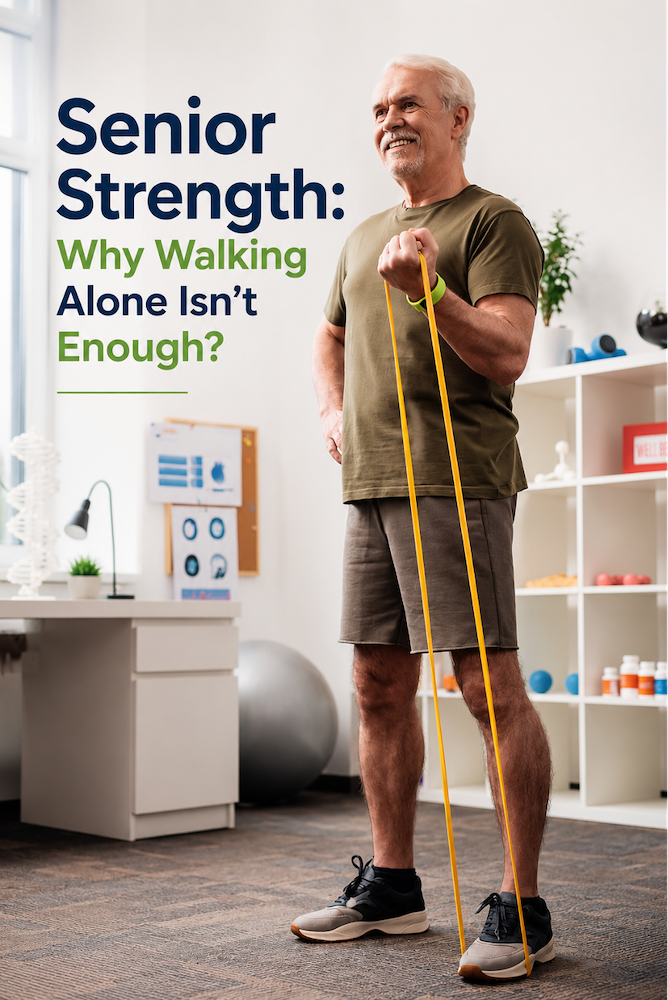
Studies also show that muscle quality improves with resistance training, even in seniors experiencing age-related muscle loss 9. The slow, controlled movements improve strength, balance, coordination, and range of motion. Resistance bands, weights, or aquatic exercises may be included in your routine.
Resources:
- PMC, June 23, 2014, Sarcopenia in older adults
https://pmc.ncbi.nlm.nih.gov/articles/PMC4066461/ - Health Harvard Publishing, April 1, 2023,
https://www.health.harvard.edu/heart-health/move-of-the-month-standing-side-leg-raise - PubMed, 2010, Regular heel-raise training focused on the soleus for the elderly: evaluation of the muscle thickness by ultrasound
https://pubmed.ncbi.nlm.nih.gov/20453430/ - Stanford Medicine, 2026, Five healthy habits for successfully aging in our 60s and 70s – and beyond
https://med.stanford.edu/news/insights/2026/01/healthy-habits-for-successful-aging-60s-and-70s.html - PMC, April 16, 2025, Heavy Strength Training in Older Adults: Implications for Health, Disease and Physical Performance
- Age UK, Functional fitness – movement for better ageing
https://www.ageuk.org.uk/information-advice/health-wellbeing/exercise/functional-fitness/ - CDC, Jan. 27, 2026, Facts About Falls
https://www.cdc.gov/falls/data-research/facts-stats/index.html - Mayo Clinic, Aug. 20, 2024, Balance exercises
https://www.mayoclinic.org/healthy-lifestyle/fitness/in-depth/balance-exercises/art-20546836 - PMC, Jan. 12, 2010, Muscle tissue changes with aging
https://pmc.ncbi.nlm.nih.gov/articles/PMC2804956/
This content comprises informative and educational resources only and can not be considered as a substitute for professional health or medical guidance. Reliance on any information provided in this article is solely at your own risk. If you have any inquiries or apprehensions about your medical condition or health goals, talk with a licensed physician or healthcare provider.




Leave A Comment